 English
 русский
 Español
 عربى
How Much Diesel Does a 10kW Generator Use? Real Load, Fuel and Runtime Guide
For a 10 kW diesel generator, plan on roughly 2.5–3.5 liters per hour (0.66–0.92 US gallons per hour) at full load. At 50% load, expect about 1.2–1.8 L/h; at 25% load, 0.8–1.2 L/h. The number is not fixed because fuel burn follows the load, not the nameplate alone. A set that powers a small workshop at 8 kW will drink noticeably more than the same set idling a few lights and a fridge.
Before you size a tank or budget a project, confirm whether the seller means 10 kW or 10 kVA. A 10 kW set at 0.8 power factor is 12.5 kVA; a 10 kVA set is only 8 kW. That difference changes fuel planning by about 20%.
Quick answer: diesel use for a 10 kW generator by load
The table below is a practical planning range for a conventional 10 kW diesel genset. It assumes a well-maintained engine, reasonable ambient conditions, and diesel with a density near 0.83–0.85 kg/L. Small engines vary, so treat the figures as a band, not a guarantee.
| Load level | Output | Diesel use | US gallons | L per kWh |
|---|---|---|---|---|
| 100% | 10 kW | 2.5–3.5 L/h | 0.66–0.92 gal/h | 0.25–0.35 |
| 75% | 7.5 kW | 1.9–2.7 L/h | 0.50–0.71 gal/h | 0.25–0.36 |
| 50% | 5 kW | 1.2–1.8 L/h | 0.32–0.48 gal/h | 0.24–0.36 |
| 25% | 2.5 kW | 0.8–1.2 L/h | 0.21–0.32 gal/h | 0.32–0.48 |
At full load, a useful rule is 0.25–0.35 L per kWh for many small diesel gensets. At light load, the engine runs less efficiently per kWh, so the liters-per-kWh figure rises even though liters-per-hour falls. That is why a 10 kW set at 25% load may use only 1 L/h but still consume more fuel per unit of useful electricity than it does at 75% load.
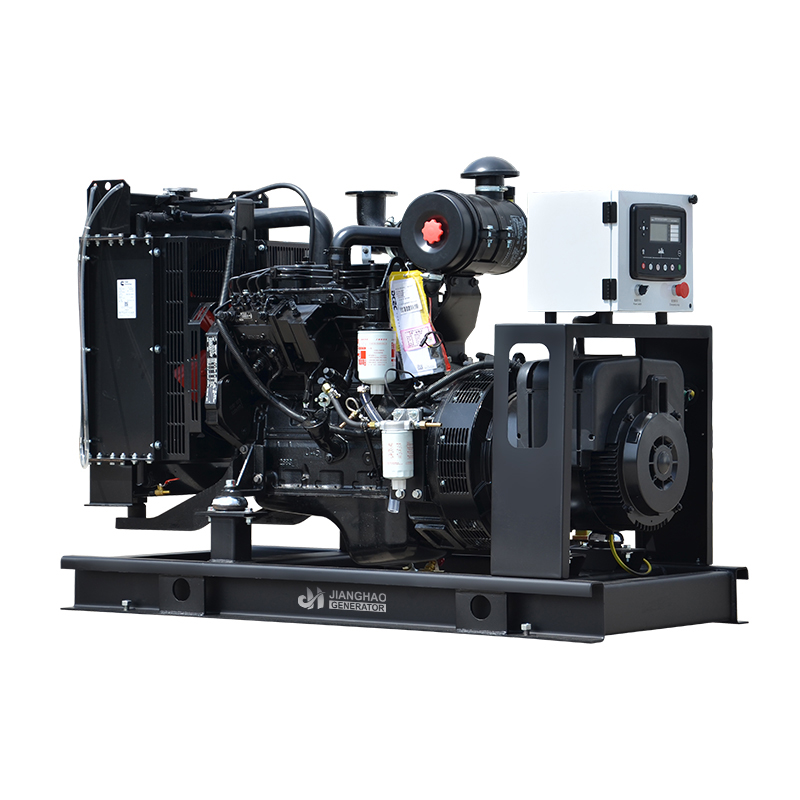 8–100 kVA Diesel Generator SetsBrowse 8–100 kVA diesel gensets from Jianghao, Cummins, Perkins, Yuchai and Weichai, with open, silent, trailer and mobile configurations for standby or prime power.View Product →
Why there is no single fuel number
Fuel consumption is an outcome of four things: the electrical load, the engine’s specific fuel consumption, the alternator efficiency, and the site conditions. The nameplate rating only tells you the ceiling. It does not tell you how the set will behave at 3 kW for eight hours a day, or at 9.5 kW for short peaks.
Load is the biggest lever
A diesel engine burns fuel to produce mechanical shaft power. The alternator converts that shaft power to electricity. If you ask for 2 kW, the engine controls deliver only enough fuel to hold speed and voltage; if you ask for 10 kW, it delivers much more. This is why two owners with the same 10 kW model can report very different fuel use. One may be running a pump and lights at 4–5 kW; the other may be running a welder and compressor near the limit.
10 kW vs. 10 kVA
Electrical ratings are often mixed in quotations. A 10 kW generator at 0.8 power factor has a 12.5 kVA alternator. A 10 kVA generator has an 8 kW real-power rating. If a supplier quotes “10 kW” but the alternator is only 10 kVA, the continuous real-power capability may be lower than expected. Always ask for the prime power rating in kW, the standby rating, and the fuel curve at 25%, 50%, 75% and 100% load.
Engine size and efficiency
A 10 kW electrical output usually requires an engine in the roughly 12–15 kW mechanical range, depending on alternator efficiency and design margins. Smaller engines tend to have higher specific fuel consumption than large industrial engines, and older mechanical injection systems may use more fuel than modern electronic systems. The difference is often small at full load but more visible at part load.
How to calculate diesel use for your own load profile
Use a simple formula: liters per hour = load in kW × specific fuel consumption in L/kWh. For a planning estimate, use 0.28–0.35 L/kWh at 75–100% load and 0.35–0.50 L/kWh at 25–50% load. Then add a 10–15% margin for startup, transient loads, and day-to-day variation.
- List every load that will run at the same time: motors, lights, pumps, tools, chargers, air conditioning.
- Convert each load to kW. For motors, use the running kW, not the starting kVA, but note the starting surge.
- Estimate the realistic simultaneous load. A 10 kW set should not be planned to run at 10 kW continuously if the site has poor ventilation or high ambient temperature.
- Apply the fuel rate. Example: 7 kW continuous × 0.30 L/kWh = 2.1 L/h.
- Multiply by running hours and add the margin. At 6 hours per day, 2.1 L/h becomes about 12.6 L/day, or roughly 378 L over 30 days.
If the load is mostly small and intermittent, the fuel rate per hour will fall, but the engine may spend more time at low load. That can increase maintenance risk, including wet stacking on some engines. A 10 kW set is usually happier at 50–80% load than at 10–20% load for long periods.
What changes the real number in the field
- Ambient temperature and altitude: Hot air and high altitude reduce engine power, so the set may need a larger unit or run at a higher fuel rate to carry the same load.
- Fuel density: Diesel density changes with temperature. A liter of warm diesel contains slightly less mass than a liter of cold diesel, which can shift consumption by a few percent.
- Maintenance: Clogged air filters, dirty injectors, low fuel pressure and restricted exhaust raise fuel use and reduce available power.
- Enclosure and cooling: A silent canopy adds cooling fan load and can slightly increase parasitic losses, though the effect is usually smaller than load variation.
- Load profile: Frequent starts, large motor surges and poor power factor can force the set to work harder than the steady-state kW figure suggests.
Choosing a 10 kW class diesel generator
For a 10 kW duty, the 8–100 kVA product range is the practical place to start. Jianghao builds diesel gensets in this band with open, silent, trailer and container configurations, and can supply fuel consumption data for a specific engine and alternator combination. The right choice depends on whether the set will run as standby power, prime power, or mobile power.
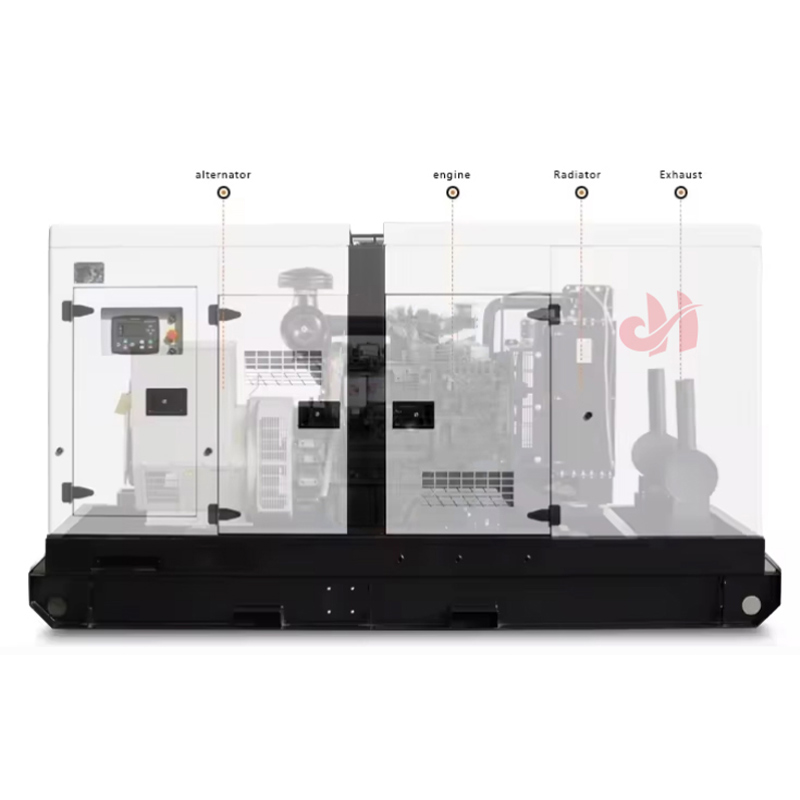 Silent Diesel Generator Sets, 8–4000 kVANoise-reduced diesel gensets from 8–4000 kVA with fully enclosed canopies and sound-absorbing materials, suited to residential, commercial, hospital and event backup power.View Product →
If noise is a constraint, a silent-type enclosure is often worth considering for a 10 kW unit near homes, shops or offices. If the set will be moved between sites, a trailer or mobile configuration may matter more than a small difference in fuel rate. For fixed standby duty, an open set with a weatherproof enclosure and a properly sized fuel tank is often the simpler choice.
Ask for the fuel curve, not just a single number. A supplier who can show liters per hour at 25%, 50%, 75% and 100% load is giving you something you can use for tank sizing and operating cost. Also confirm the prime and standby ratings, the alternator efficiency, and the maximum allowable load step for motor starting.
Fuel storage, runtime and operating cost
Runtime follows tank size and load. A 100 L tank gives roughly 28–40 hours at full load on a 10 kW set, but 55–83 hours at 50% load. A small 20 L tank may only last 6–8 hours at full load. That is enough for short outages but not for multi-day prime power unless you arrange refueling.
- Keep the tank sized for your realistic refueling interval, not the best-case fuel rate.
- Allow for a 10–15% reserve and for fuel that cannot be drawn from the bottom of the tank.
- Use clean, water-free diesel and replace filters on schedule; fuel quality affects both reliability and consumption.
- For long runs, check oil level and coolant daily, and follow the manufacturer’s service intervals.
As a cost example, at $1.20 per liter, a 10 kW set at full load using 3 L/h costs about $3.60 per hour. At 50% load using 1.5 L/h, it costs about $1.80 per hour. Over 500 hours per year, that difference is roughly $900. The load profile is therefore a financial decision as well as a technical one.
Buying checklist before you commit
- Confirm the real power rating in kW, not only kVA.
- State the load profile: continuous, standby, or mixed daily use.
- Request fuel consumption at 25%, 50%, 75% and 100% load.
- Check derating for altitude and ambient temperature.
- Confirm tank size, refueling access and spill containment requirements.
- Review noise limits if the set will run near people or property boundaries.
- Ask for the maintenance schedule and the recommended oil and filter intervals.
For a broader view of sizing, the site’s sizing guide for 8–4000kVA diesel generator sets is a useful next step. The key is to match the set to the load, not to a round number on a brochure.
For most 10 kW diesel generator projects, a realistic budget is 2.5–3.5 L/h at full load and 1.2–1.8 L/h at half load. If you need one number for planning, use 3 L/h at full load and 1.5 L/h at half load, then adjust with the supplier’s fuel curve. That approach gives you a safer tank size, a clearer operating cost, and fewer surprises when the load is not exactly what you expected.