 English
 русский
 Español
 عربى
Diesel Generator CO2 Output: How Much CO2 Does a Diesel Genset Produce?
Short answer: a diesel generator produces about 2.68 kg of CO2 for every litre of diesel it burns. A 100 kW generator at full load typically burns 20 to 25 litres per hour, so it emits roughly 54 to 67 kg of CO2 per hour. Per kWh, expect something closer to 0.55 to 0.80 kg of CO2, with the higher end appearing when the set runs at low load, is oversized, or is poorly maintained.
The exact number is not fixed by the generator's kVA rating. It is fixed by the fuel burned. That is why a 500 kVA set running at 400 kW can produce less CO2 per kWh than the same 500 kVA set running at 100 kW. Diesel engines usually breathe and burn more efficiently near their design load. Two generators with the same nameplate output can therefore report very different annual CO2 totals once the load profile and run hours are known.
Why 2.68 kg per litre is the number to start with
Diesel is mostly carbon. When it burns, the carbon combines with oxygen to form CO2. The widely used combustion factor is about 10.18 kg of CO2 per gallon of diesel, which converts to about 2.68 kg per litre. This is a combustion factor, not a full lifecycle factor. It covers the CO2 released at the exhaust, not the extra emissions from extracting crude oil, refining diesel, and transporting it to site. Lifecycle studies often add roughly 10 to 20 percent, depending on the supply chain and the boundaries used.
For most site-level carbon reporting, the fuel invoice is the strongest starting point. If a generator burns 1,000 litres of diesel, the combustion CO2 is about 2.68 tonnes. If the site burns 20,000 litres in a year, the combustion CO2 is about 53.6 tonnes before any lifecycle adjustment. If fuel records are incomplete, the next best method is to estimate fuel consumption from load and specific fuel consumption, then apply the same factor.
The basic formula is simple:
- CO2 per hour (kg/h) = fuel burned per hour (L/h) x 2.68
- CO2 per kWh (kg/kWh) = fuel burned per kWh (L/kWh) x 2.68
- Annual CO2 (kg) = CO2 per hour (kg/h) x annual run hours
That formula is deliberately plain, because the uncertainty usually sits in the fuel consumption figure, not in the carbon factor. A generator catalogue may quote fuel use at 100 percent load, but a real site may run at 40 percent load for most of the year. The carbon factor stays stable; the fuel burn changes.
What the per-kWh number looks like in practice
Specific fuel consumption for modern diesel generator sets commonly falls around 0.20 to 0.25 litres per kWh at or near full load. That gives about 0.54 to 0.67 kg of CO2 per kWh. At half load, the engine may need 0.24 to 0.30 litres per kWh, pushing the figure toward 0.64 to 0.80 kg per kWh. Very small sets, old engines, and badly matched loads can go higher.
The table below gives indicative ranges. It is not a substitute for a manufacturer's fuel curve, but it shows the order of magnitude and why load matters.
| Rated output | Fuel at 100% load (L/h) | CO2 at 100% load (kg/h) | CO2 per kWh at 100% load (kg) | Indicative CO2 at 50% load (kg/h) |
|---|---|---|---|---|
| 30 kW | 6 to 7.5 | 16 to 20 | 0.54 to 0.67 | 10 to 14 |
| 100 kW | 20 to 25 | 54 to 67 | 0.54 to 0.67 | 32 to 40 |
| 250 kW | 50 to 62.5 | 134 to 168 | 0.54 to 0.67 | 80 to 94 |
| 500 kW | 100 to 125 | 268 to 335 | 0.54 to 0.67 | 161 to 188 |
| 1,000 kW | 200 to 250 | 536 to 670 | 0.54 to 0.67 | 322 to 375 |
Remember that generator ratings are often given in kVA, while fuel consumption follows the actual kW load. A 500 kVA set at 0.8 power factor is a 400 kW set at full load. If it carries only 200 kW, use the 50 percent load row for that machine, not the full-load row.
 Diesel Generator Sets by Engine, Power and TypeCompare diesel generator ranges by engine brand, power band and open, silent, trailer or container configuration before assessing load and emissions.View Product →
Annual CO2: three realistic scenarios
Annual emissions are where the numbers become useful for procurement, permits, and carbon reporting. A backup generator that runs 50 hours a year is a different carbon asset from a prime-power generator that runs 6,000 hours a year, even if both carry the same nameplate rating.
Data center standby power
Consider a 2,000 kW standby plant tested for 200 hours a year at an average 50 percent load. The average load is 1,000 kW. At 0.22 L/kWh, fuel use is about 220 L/h. CO2 is about 590 kg/h. Over 200 hours, that is about 118 tonnes of CO2. If the same plant runs at 80 percent load for those test hours, fuel use and CO2 rise, but the CO2 per kWh may improve slightly because the engines are working closer to their efficient band. The key planning point is that test hours and outage hours both count.
 1000–4000 kVA High-Power Diesel GensetsReview high-power diesel generator sets for heavy industry, healthcare and data centers, with engine-brand and open, silent or containerized configuration options.View Product →
Mine or remote industrial site
A 500 kW prime-power generator running 6,000 hours a year at 70 percent load carries 350 kW. At 0.23 L/kWh, fuel use is about 80.5 L/h. CO2 is about 216 kg/h. Over 6,000 hours, that is roughly 1,296 tonnes of CO2. At that scale, a 5 percent improvement in fuel consumption saves about 65 tonnes of CO2 a year, which is often easier to justify than a change in generator size alone.
Construction or rental site
A 30 kW set running 8 hours a day for 200 days at 60 percent load carries 18 kW. At 0.27 L/kWh, fuel use is about 4.9 L/h. CO2 is about 13 kg/h. Over 1,600 hours, that is about 21 tonnes of CO2. The absolute number is modest, but the per-kWh figure is high because the set is small and lightly loaded. On rental sites, right-sizing and avoiding long idle periods can matter as much as engine technology.
What changes the number, and what does not
Engine efficiency is the first variable. A modern common-rail diesel engine with good combustion control usually burns less fuel per kWh than an older mechanical engine. That difference shows up directly in CO2. A 10 percent fuel saving is a 10 percent CO2 saving, because the carbon factor per litre is essentially fixed.
Load factor is the second. Diesel generators are often selected with a margin for starting motors, future load, or redundancy. That margin is useful for reliability, but a set that spends most of its life below 30 percent load can suffer wet stacking, incomplete combustion, and higher fuel consumption per kWh. If the load profile is likely to stay low, a smaller set or a multi-unit arrangement may produce lower emissions than one oversized unit. For projects that need to match load across several engines, [parallel generator systems](/customized/parallel.html) can bring units online as demand rises instead of running one large set lightly loaded.
Maintenance is the third. Clogged air filters, dirty injectors, incorrect valve clearance, low coolant temperature, and exhaust restrictions all tend to increase fuel use. A generator that is healthy at commissioning but neglected after two years may emit more CO2 per kWh without any visible failure. Fuel quality also matters, though mostly at the margins. Water, sediment, and poor cetane can upset combustion and increase consumption.
Site conditions matter too. High altitude reduces air density, so the engine may derate and burn more fuel for the same useful output. High ambient temperature can reduce charge-air cooling effectiveness. Exhaust aftertreatment for NOx and particulate matter is important for local air quality, but it does not remove CO2. In some cases, aftertreatment systems can slightly increase fuel use because of regeneration or backpressure. That is a trade-off between local pollutants and CO2, not a CO2 reduction measure.
Biofuel blends change the fossil CO2 picture, but not the combustion chemistry in a simple way. A B7 or B20 blend contains renewable carbon, so the fossil CO2 attributed to the fuel can fall. The lifecycle result depends on feedstock, land use, and processing. For most industrial sites, the practical first step is still to measure litres burned and run hours, then improve efficiency before changing fuel.
How to estimate CO2 for a specific generator
Start with the load profile, not the nameplate. A generator's CO2 output is a function of actual kW, run hours, and fuel consumption. A simple estimate is enough for a first screening, but a procurement decision deserves a fuel curve.
- List the generator's rated kW and the expected average load in kW.
- Ask for specific fuel consumption at 25, 50, 75, and 100 percent load. If only one figure is available, use a conservative range and state the assumption.
- Multiply average load by specific fuel consumption to get litres per hour.
- Multiply litres per hour by 2.68 to get kg of CO2 per hour.
- Multiply by annual run hours to get annual CO2.
- Check the result against fuel purchase records. If the estimate and the invoices disagree by more than about 10 to 15 percent, revisit the load profile and fuel curve.
For example, a 250 kW set running at 60 percent load carries 150 kW. At 0.24 L/kWh, it burns 36 L/h. CO2 is about 96.5 kg/h. At 800 run hours a year, annual CO2 is about 77 tonnes. If the same set runs 4,000 hours a year, the figure rises to about 386 tonnes. The formula is simple; the honesty of the load and run-hour assumptions is what makes the result useful.
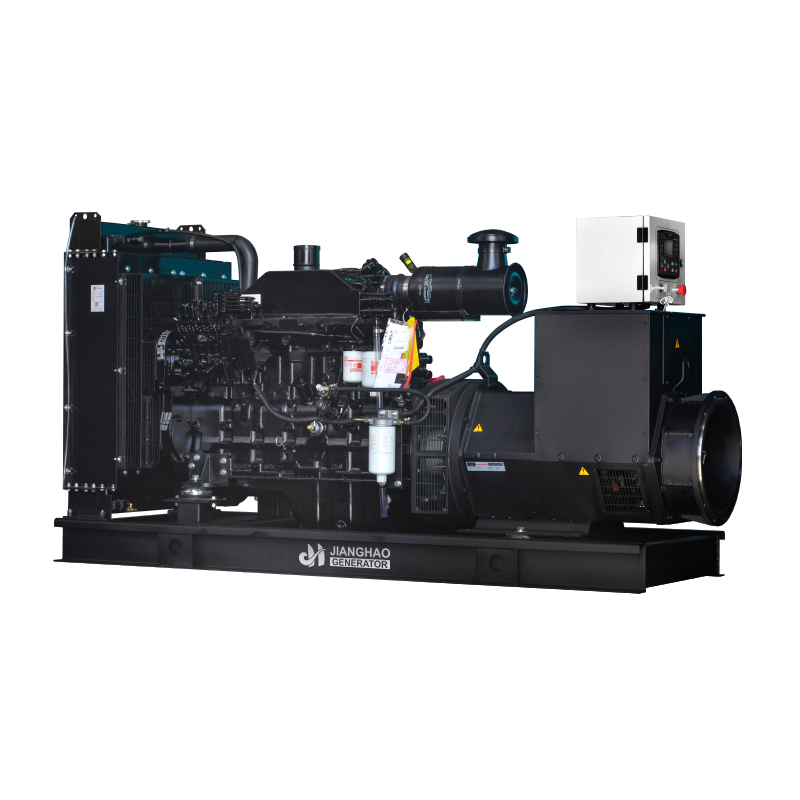 100–300 kVA Diesel Generator SetsCompare 100–300 kVA diesel gensets across engine brands and open, silent or trailer types, with 50 Hz and 60 Hz model tables for load planning.View Product →
Procurement and reporting points that are easy to miss
Do not accept a single fuel consumption number at 100 percent load as a carbon estimate. A generator that is specified for standby duty may never reach 100 percent load except during a test. A set specified for prime power may run at 70 percent load for thousands of hours. The same engine can produce very different annual CO2 totals in those two roles. Ask for a fuel curve, a guaranteed specific fuel consumption tolerance, and the test conditions behind the numbers.
For carbon reporting, keep fuel invoices, tank logs, and run-hour records together. If the site uses a bulk tank, reconcile deliveries against consumption. If the generator is part of a larger project, separate diesel combustion from grid electricity and from other fuels. That separation matters because diesel combustion is usually Scope 1 for the site, while purchased electricity is Scope 2. A combined number is less useful for identifying where the emissions actually come from.
Electrical design can change the project layout, but it does not change the fuel-based CO2 formula. For projects with long cable runs or high distribution voltage, [high-voltage generator sets](/customized/highvoltage.html) may reduce losses and simplify the balance of plant, yet the CO2 still tracks the litres burned. The same is true for containerized, silent, or trailer-mounted packaging. Enclosure and mobility affect site planning, noise, and maintenance access; they do not change the carbon content of diesel.
A practical procurement checklist should include the expected load profile, annual run hours, fuel consumption at part load, fuel storage capacity, maintenance intervals, and the reporting method. If the project has a carbon target, ask the supplier to model the annual CO2 at 25, 50, 75, and 100 percent load rather than providing one headline figure. That model will show whether the generator is likely to run efficiently or spend its life in a low-load band where CO2 per kWh is poor.
So how much CO2 does a diesel generator produce? Use 2.68 kg per litre as the combustion factor, then work back through fuel consumption. A 100 kW set at full load is roughly 54 to 67 kg per hour; a 1,000 kW set is roughly 536 to 670 kg per hour. Per kWh, the realistic band is about 0.55 to 0.80 kg, with load factor, engine efficiency, and maintenance deciding where the site lands. The generator's kVA rating tells you its capacity. The fuel curve and run hours tell you its carbon output.