 English
 русский
 Español
 عربى
عربىDo Diesel Generators Have Spark Plugs? How Diesel Ignition Really Works
A maintenance planner at a cold-storage warehouse orders winter spares for the facility's standby generator: fuel filters, a water separator element, two batteries, a jug of coolant, and, almost as an afterthought, a set of spark plugs. The parts counter sends back a polite correction. There is nowhere on a diesel generator set to fit them.
That small moment of confusion sits behind one of the most common questions about backup power equipment, and the answer deserves to be stated plainly: a diesel generator set does not have spark plugs. A diesel engine ignites its fuel using heat created by compressing air, not with an electric arc. There is no spark plug, no ignition coil, no distributor, no high-tension lead and no spark timing circuit anywhere on the engine.
What a diesel engine does have, and what people are often looking at when they assume a spark must exist somewhere, is a small family of starting aids: glow plugs on some engines, intake air heaters, coolant and oil heaters, and a substantial battery bank. All of them help the engine reach the condition in which compression ignition happens on its own. None of them produce a spark.
This article explains how diesel ignition actually works, why glow plugs are so often mistaken for spark plugs, which generator types genuinely do use plugs, what belongs in the spares cabinet instead, and how the answer changes the way a machine should be specified, maintained and troubleshot.
The Direct Answer, and Why It Matters
A diesel generator will not start better because you replaced its spark plugs, because it never had any. There is nothing in the cylinder head or in the maintenance schedule to gap, torque, clean or replace as an ignition component. Understanding that saves money on unnecessary parts, saves time in diagnosis, and prevents a genuinely harmful mistake: trying to fit automotive ignition hardware into an engine that has no place for it, or reaching for starting fluid when the real problem is air in the fuel line.
The distinction matters most in the spares room. For a diesel set, the consumables that actually keep the machine reliable are fuel filters, water separators, lubricating oil, coolant, batteries, belts, hoses, sensors and, where fitted, glow plugs or air heater elements. For a natural gas or gasoline unit, spark plugs are a legitimate and recurring line item. Mixing the two lists is how money gets spent on parts that sit on a shelf for a decade and how the genuine fault gets overlooked for one more failed start attempt.
The confusion usually comes from one of three places. Glow plugs sit in the same location and look similar at a glance. Many facilities run a small petrol generator alongside a large diesel one, and the petrol unit does need plugs. And manufacturer documentation for mixed fleets often uses the word "ignition" in both contexts, even though the two systems share almost nothing.
How Compression Ignition Replaces the Spark
In a spark-ignition engine, air and fuel are mixed before or during the intake stroke, compressed to a moderate ratio, and then ignited by an arc of roughly 20,000 to 40,000 volts jumping a plug gap at a precisely timed moment. The ignition system exists to decide when that arc occurs and to deliver enough energy for it to jump reliably under boost and load.
Air compression raises temperature above the fuel's ignition point
A diesel engine compresses air alone at ratios between roughly 14:1 and 23:1. Naturally aspirated industrial engines commonly sit around 16:1 or 17:1, while turbocharged units often use a slightly lower ratio because boost pressure already fills the cylinder with more air mass. Compressing air that hard raises its temperature to roughly 700 to 900 degrees Celsius, far above the autoignition temperature of ordinary diesel fuel, which typically falls between 210 and 350 degrees Celsius depending on fuel quality. The fuel ignites almost the instant it is sprayed into the cylinder. No external ignition source is needed, and none is provided.
Injection timing, not spark timing, controls combustion
What functions as ignition timing in a diesel is injection timing. The pump or electronic injector delivers fuel a defined number of crankshaft degrees before top dead centre. When combustion actually begins is influenced by injection pressure, the number and diameter of the nozzle holes, the temperature of the air charge, and the fuel's cetane number, which measures how readily the fuel self-ignites. Ordinary number 2 diesel generally has a cetane number around 45 to 55. Low-cetane, aged or contaminated fuel lengthens the ignition delay, which is heard as a harder knock and seen as white smoke and rough running right after a cold start.
Because there is no spark to time, there is also no ignition coil, no distributor, no plug wire, no ignition module and no spark advance mechanism. On a modern electronically controlled diesel, injection quantity and timing are managed by a control module reading crankshaft and camshaft position, fuel rail pressure, boost pressure, intake air temperature and coolant temperature. That combination is the closest thing a diesel has to an ignition system, and it operates entirely through the fuel system.
Glow Plugs, Air Heaters and Block Heaters: The Hardware People Mistake for Spark Plugs
At the top of a diesel cylinder head, or on the intake manifold, you will sometimes see components that look like they belong in an ignition system. They do not, and understanding what each one does removes most of the confusion.
Glow plugs are heaters, not electrodes
A glow plug is a small resistive element that screws into a prechamber or directly into the combustion chamber. When the control circuit energises it, the tip glows orange, typically reaching 850 to 1,000 degrees Celsius within 5 to 20 seconds, warming the surrounding air or prechamber so that compression ignition begins reliably on the first few revolutions. It does not create a spark across a gap, and there is no gap to set.
Glow plugs are most common on older indirect-injection engines and on some smaller direct-injection units intended for cold climates. Many modern direct-injection industrial engines use an intake air heater instead, and some engines use both. Testing is straightforward: a healthy plug usually shows a resistance in the region of 0.5 to 2 ohms, though the exact figure should always be verified against the engine manual. It should draw current when energised and glow visibly if removed and bench-tested. If a cold engine cranks for 8 to 10 seconds without firing and the preheat indicator never stays lit, suspect the relay, the timer or the fuse before condemning the plugs themselves.
Intake air heaters and flame-start devices
An intake air heater is a grid or coil element mounted inside the intake manifold that warms the charge air as it enters the engine. A flame-start device goes a step further and burns a small amount of fuel in the intake stream to heat the incoming air, which allows cranking at ambient temperatures of minus 30 degrees Celsius and below. Both operate only during starting. Neither runs once the engine is at operating temperature, and neither is an ignition device in any meaningful sense.
Coolant and oil heaters keep the engine ready
A coolant heater of 1 to 3 kilowatts circulates warm coolant through the block so the engine sits at 20 to 40 degrees Celsius before it starts; an oil pan heater does the same for the lubricant. The benefits are easier cranking, less cylinder wear at startup, faster acceptance of load after transfer, and noticeably less white smoke. In cold-climate packages, this heater family, together with higher-capacity batteries and appropriate lubricating oil, is what allows a diesel generator to be quoted for dependable starting in very low ambient temperatures. It is also why a generator left unheated overnight at minus 20 degrees behaves very differently from one that has been on a block heater for six hours.
Where Spark Plugs Actually Do Belong on a Generator Site
Spark plugs are not obsolete on generator sites; they simply belong on a different machine. Any generator set whose engine runs on the Otto cycle and ignites a premixed air-fuel charge will have spark plugs, an ignition coil or a magneto, and a spark timing strategy.
The clearest example is the natural gas generator set. Gas engines burn methane-rich fuel, need a controlled ignition point, and typically use one or more spark plugs per cylinder with individual coils, often backed by a capacitive discharge ignition system. Because gas engines run hotter and leaner than petrol engines, industrial spark plugs are consumables. Replacement intervals of roughly 1,000 to 4,000 hours are common, with the exact figure depending on whether the engine is stoichiometric or lean-burn, on gas quality and on plug specification. Misfire in a gas engine is normally detected through exhaust temperature monitoring and shows up as a drop in output and a rise in emissions, and the first components a technician checks are the plug and the coil.
 Natural Gas Generator Sets by Yuchai, Weichai, and CumminsCategory covering natural gas generator sets from Yuchai, Weichai, and Cummins, relevant to spark-ignition maintenance and emissions discussions.View Product →
Gasoline portable generators also use spark plugs, and this is a large part of why the confusion persists. A single facility can easily own a diesel standby set, a gas cogeneration unit and a small petrol set for site work. Dual-fuel engines that burn gas with a diesel pilot injection remain compression ignition: the small diesel quantity ignites from compression heat and the gas charge follows, so no spark plug is required there either.
The practical consequence for a spares room is a labelling problem rather than a technical one. If a site runs both diesel and gas units, spark plugs should be stocked against the gas sets only. Nothing on the diesel side of the shelf should be ordered to fit them.
What Is Actually Mounted on a Diesel Generator Engine
The answer becomes easier to remember once you know what the hardware really is. Working from the air intake toward the alternator, a diesel generator set contains the following systems and components.
- Air intake: filter element, restriction indicator, turbocharger on many industrial ratings, charge air cooler and intake manifold.
- Fuel system: main tank or day tank, lift or primer pump, water separator and sedimenter, primary and secondary filters, low-pressure lines, high-pressure pump or common rail, injectors and return line.
- Cooling: radiator, fan, thermostat, water pump, coolant, and on many units a coolant heater.
- Lubrication: oil pump, oil filter, oil cooler, pressure sender and low-oil-pressure shutdown switch.
- Starting: 24 volt battery bank, battery charger, starter motor and solenoid, key or auto-start control, and a preheat circuit for glow plugs or an air heater where fitted.
- Governing and protection: mechanical governor or electronic control module, speed sensor, actuator, and safety shutdowns for overspeed, high coolant temperature, low oil pressure and low coolant level.
- Generator end: excitation system, automatic voltage regulator, rotating diodes, main circuit breaker and terminal connections.
Nothing on that list creates an electric arc inside a cylinder. The components that come closest in appearance are the glow plug, which is a heater, and the injector, which is a precision hydraulic device. Neither has a gap to set or a plug wire to replace.
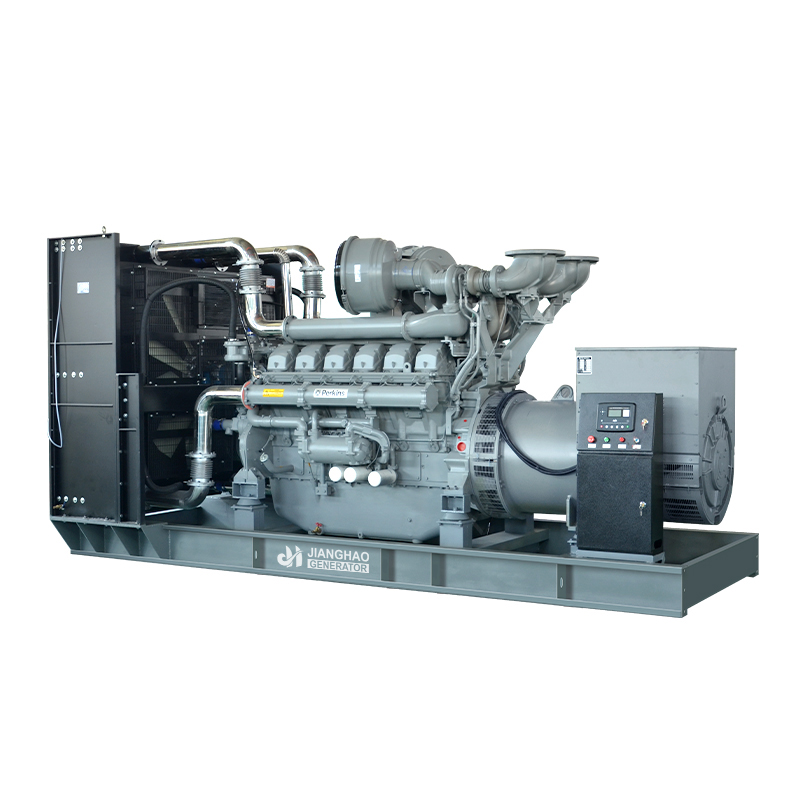
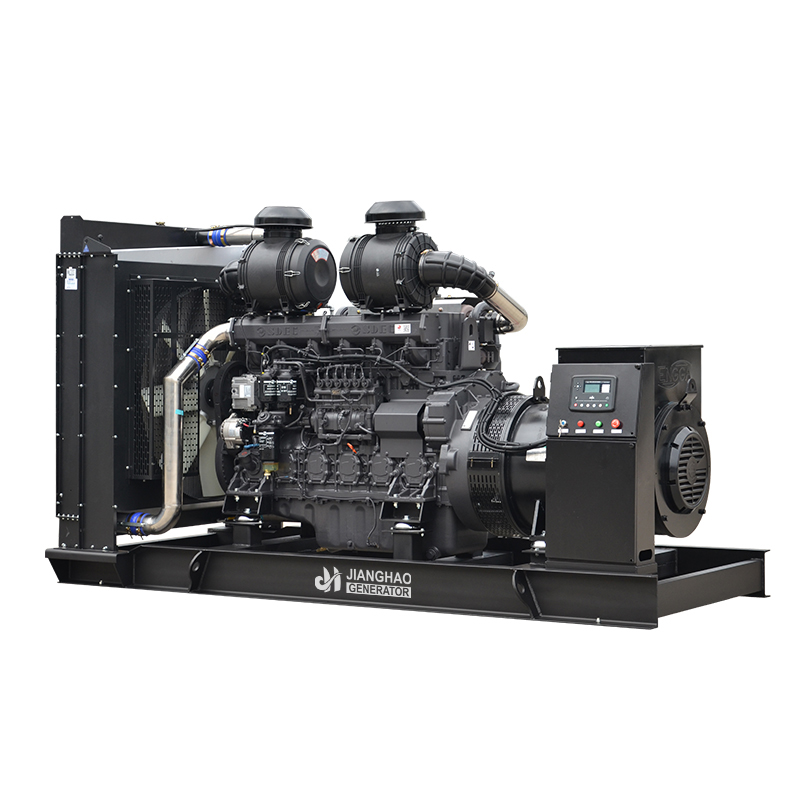
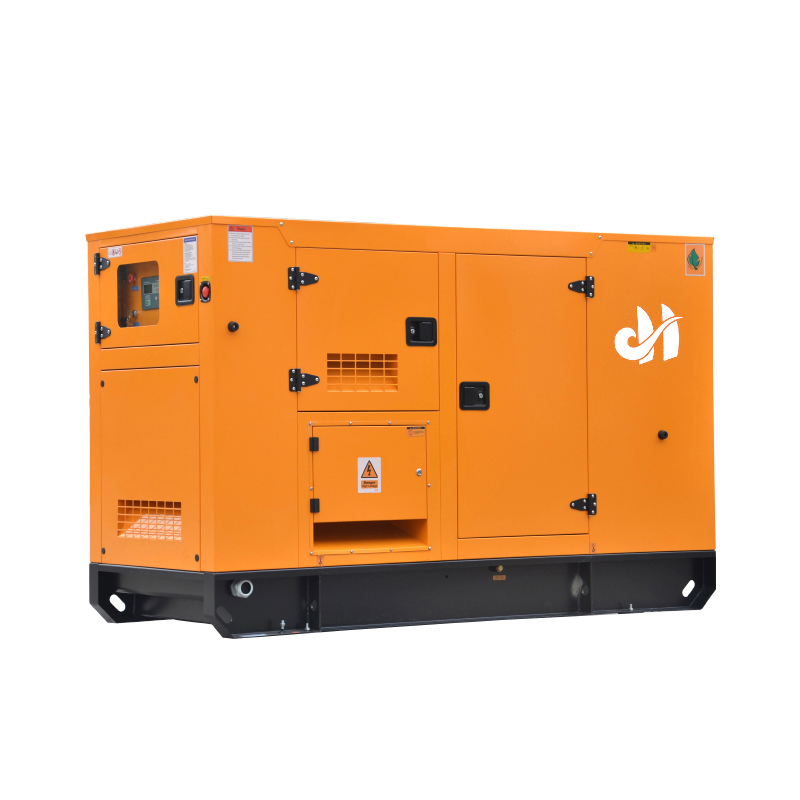
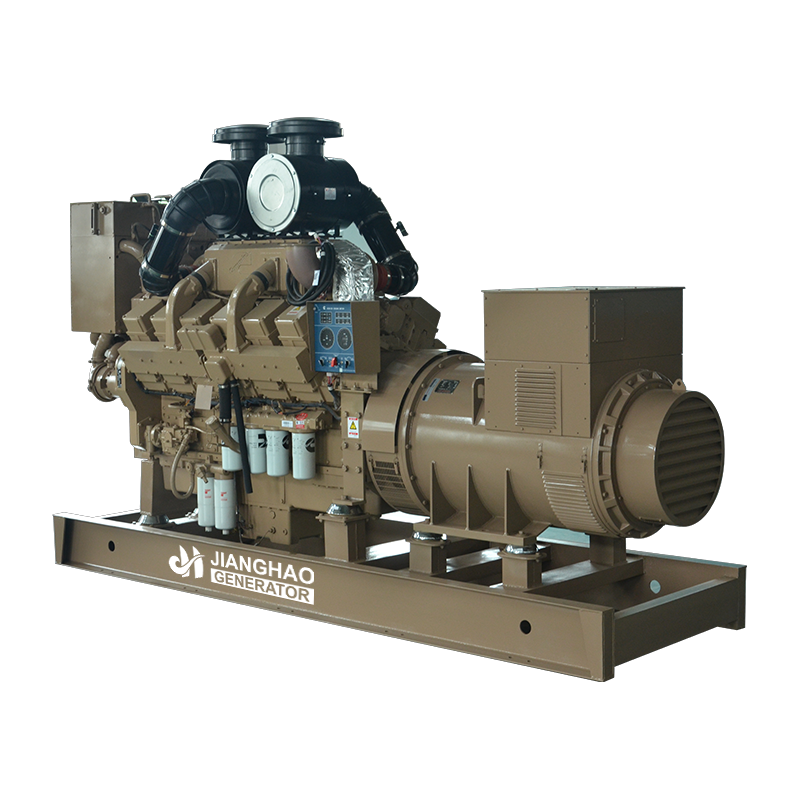
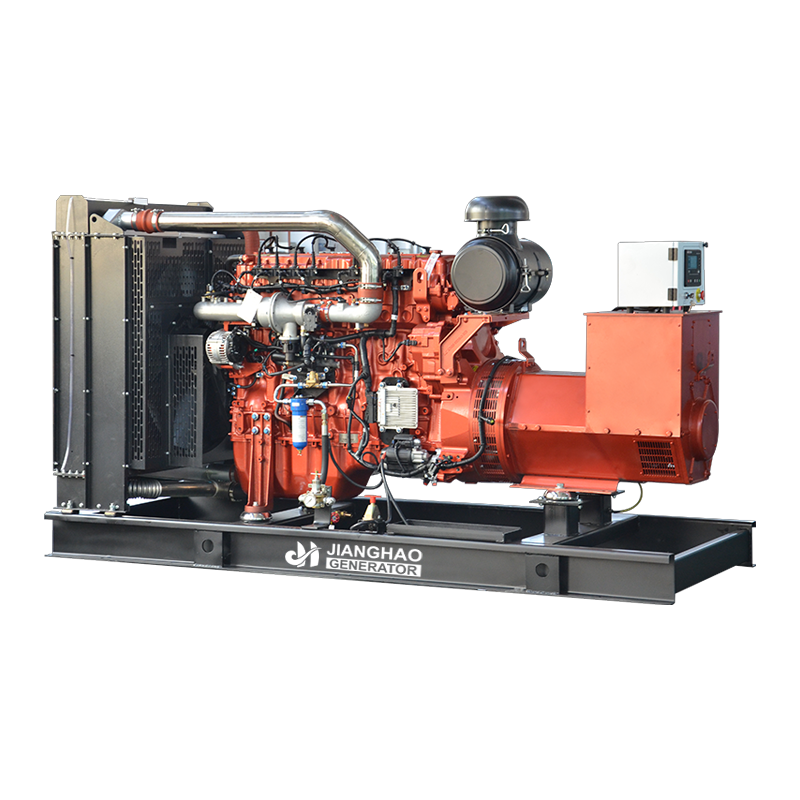
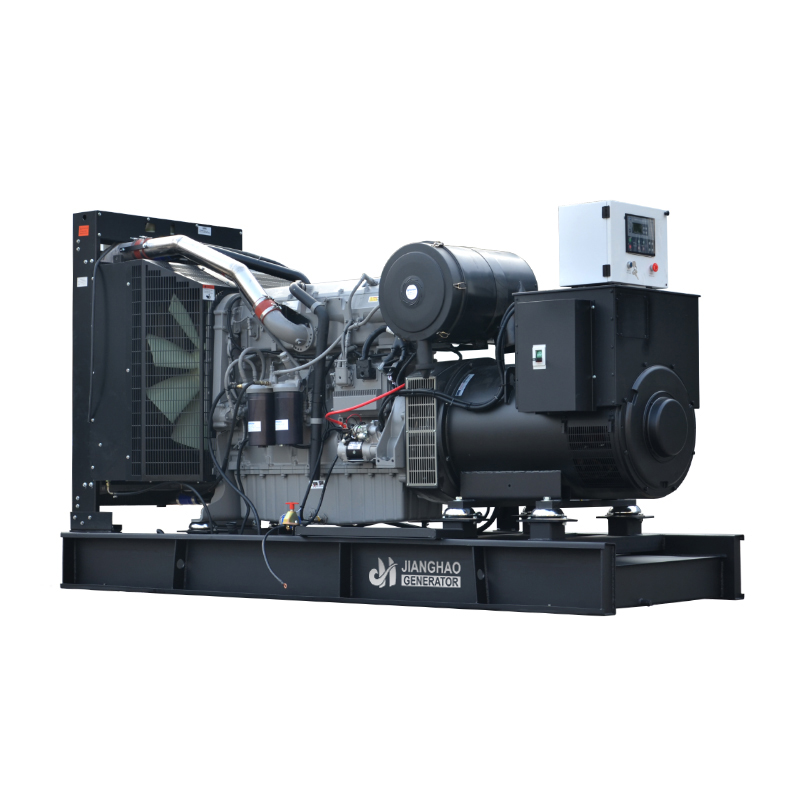
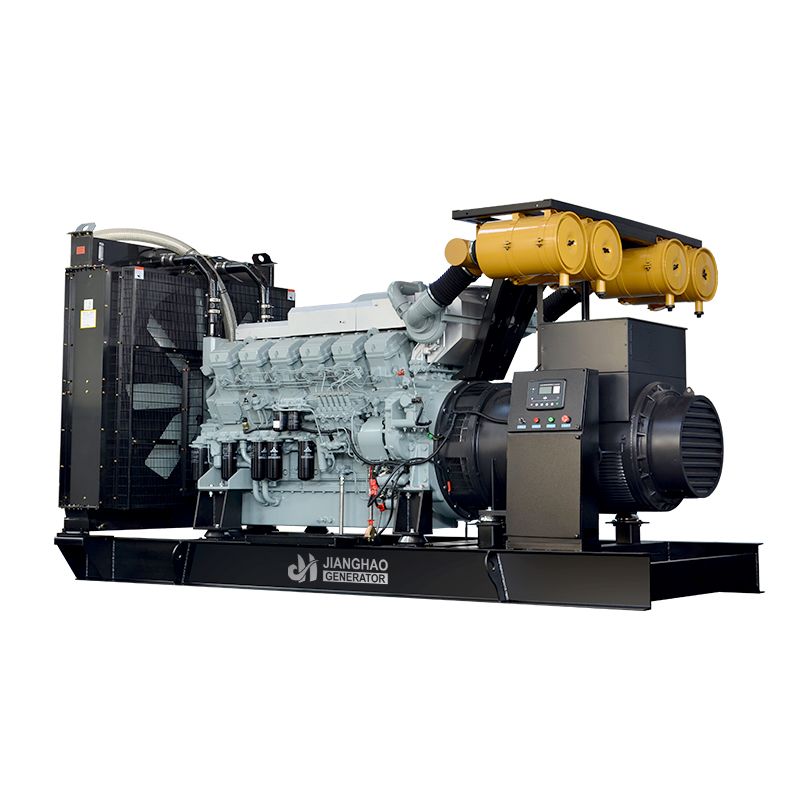
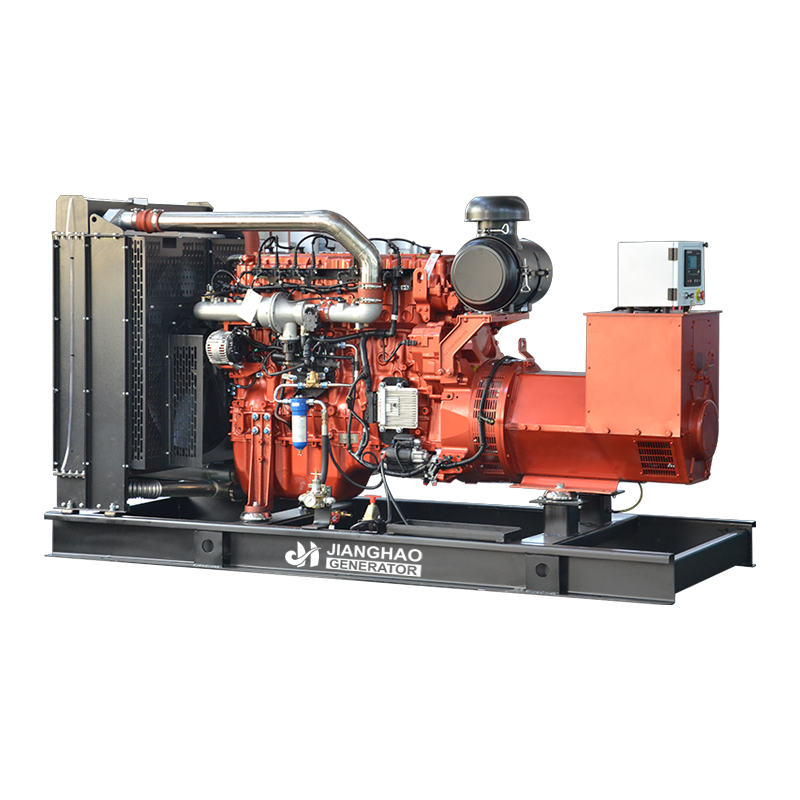
 Diesel Generator Sets by Engine Brand, Power, and StructureDiesel genset category grouping Cummins, Perkins, MTU, Mitsubishi, Yuchai, Baudouin, Weichai, and Volvo engine options; relevant to compression-ignition and injection discussion.View Product →
| Engine type | How the fuel is ignited | Starting aids typically fitted | Recurring ignition-related service |
|---|---|---|---|
| Diesel, compression ignition | Heat from air compressed to roughly 700 to 900 degrees Celsius auto-ignites the injected fuel | Glow plugs on some indirect-injection and small direct-injection units, intake air heater, flame-start device, coolant and oil heaters | Injector testing and cleaning, fuel filter and water separator replacement, valve lash adjustment |
| Natural gas, spark ignition | Spark plug fires a premixed air and gas charge, timed by an ignition module or magneto | Ignition coils, gas train, throttle actuator, sometimes a preheat cycle | Spark plug replacement, coil replacement, plug gap verification, ignition timing checks |
| Gasoline, spark ignition | Spark plug fires a premixed air and petrol charge | Choke or automatic enrichment, small starter motor | Spark plug cleaning or replacement, air filter, ignition lead inspection |
| Dual fuel with diesel pilot | Small diesel pilot quantity ignites from compression heat, then the gas charge burns | Coolant heater, battery bank, air heater in cold climates | Pilot injector service, gas valve maintenance, fuel filters |
The Fuel Injection System Is the Closest Thing a Diesel Has to an Ignition System
If a diesel had an ignition system, it would be the injection system, and that is where diagnostic attention belongs when combustion goes wrong.
Injection hardware in outline
Older and mid-generation industrial engines use an inline mechanical pump or a rotary distributor pump that pressurises fuel to roughly 200 to 1,200 bar and delivers it through steel lines to each injector. Unit injectors and unit pumps raise pressure with a cam-driven plunger inside the cylinder head. Modern common-rail systems separate pressure generation from injection and reach 1,800 to 2,500 bar or more. That higher pressure allows several injection events per cycle: a small pilot injection to soften the pressure rise and quiet combustion, a main injection for power, and post injections to manage emissions and exhaust temperature. The nozzle itself is a precision component with five to eight holes, each a few tenths of a millimetre across.
Symptoms that get mistaken for ignition faults
When a diesel misfires, is hard to start or smokes, the cause lies in the fuel, the air or the compression. Worn or coked nozzles produce poor atomisation, which lengthens the ignition delay, sharpens the combustion knock, produces white smoke during warm-up and raises fuel consumption. A needle sticking in one injector can leave a single cylinder running cold, which shows up as a vibration and a cooler exhaust port on that cylinder. Air drawn into the low-pressure side, a classic consequence of a careless filter change, makes starting difficult across every cylinder. Water in the fuel damages pump and nozzle surfaces over time. Cold fuel can also gel: summer-grade diesel begins forming wax crystals as temperatures approach its cloud point, which is why winter-grade or additised fuel matters for any generator expected to start below minus 10 degrees Celsius.
Diagnosis follows the fuel path rather than the electrical path. Measure return flow from each injector, compare exhaust port temperatures across cylinders, test injectors on a pop tester, check transfer pump pressure, and only then consider a compression test. Replacing an ignition component is not a step in that sequence because there is no such component to replace.
When a Diesel Generator Will Not Start: A Practical Check Order
Because there is no ignition system to fail, the diagnostic path is short and physical. The order below works for most industrial diesel sets and avoids the temptation to swap parts at random.
- Confirm cranking speed. A 24 volt system should hold at least 22 volts while cranking; slower cranking compresses air less effectively and heat build-up falls below the ignition threshold.
- Check fuel level, tank valves and the day tank. A closed valve or an empty day tank accounts for a surprising share of no-start calls.
- Drain the water separator and inspect the primary filter for water, wax or debris, especially after a cold night.
- Bleed air from the low-pressure fuel lines and filter housing, then re-check for leaks at every joint you touched.
- Verify the fuel shut-off solenoid or stop lever is in the run position and that the linkage is not jammed.
- On engines with glow plugs or an air heater, confirm the preheat cycle actually completes before cranking begins.
- Read the control panel for fault codes and confirm the emergency stop button and any remote stop contact are released.
- Check intake restriction and exhaust back pressure; a blocked air filter or a collapsed exhaust flex section will prevent starting just as effectively as a fuel fault.
- If cranking is fast and fuel is clean, test compression on each cylinder before assuming an electrical fault.
- Review ambient conditions: oil viscosity, coolant heater operation and fuel cloud point all change behaviour at low temperature.
Two of those steps deserve emphasis because they cause most repeat visits. First, air in the fuel system after a filter change is the single most common self-inflicted no-start condition on a diesel generator, and bleeding properly takes minutes while guessing takes hours. Second, a battery bank that measures fine at rest can collapse under cranking load; the only meaningful test is voltage under load and, ideally, a conductance test on each battery.
Note what does not appear anywhere in that list: plug gap, ignition coil, spark timing, distributor cap. Those items belong to a different engine family entirely.
Maintenance Work That Stands In for Spark Plug Service
On a spark-ignition engine, ignition service is a recurring line item with a known interval. On a diesel, that budget and that labour time go into the fuel system, the starting system and the cooling system instead. The intervals below reflect common industry practice for industrial diesel generator sets and should always be adjusted to the engine manufacturer's schedule for the specific model and duty.
| Item | Typical interval | What to check |
|---|---|---|
| Drain water separator and inspect fuel | Weekly, and before every long run | Water, sediment, cloudiness, signs of microbial growth |
| Engine oil and oil filter | 250 to 500 hours or annually | Oil condition, oil analysis trends, filter housing seals |
| Fuel filters and water separator element | 250 to 500 hours or annually | Restriction, contamination, correct bleeding after change |
| Air filter element | On restriction indicator, typically 500 to 1,000 hours | Restriction reading, element damage, housing sealing |
| Coolant condition and inhibitor level | Test at 500 hours, replace every 2 to 3 years | pH, inhibitor concentration, freeze point, hose condition |
| Valve lash adjustment | 500 to 1,000 hours, per manufacturer | Clearances on intake and exhaust valves, rocker condition |
| Injector test and service | 2,000 to 6,000 hours depending on fuel quality | Return flow, spray pattern, pop pressure, exhaust port temperatures |
| Battery and charger | Monthly visual check, replace at 3 to 5 years | Terminal condition, electrolyte or conductance, charger output, cranking voltage |
| Load bank test | Monthly run at load, annual full-load test | Ability to hold rated load, coolant and oil temperature stability, governor response |
| Glow plug or air heater circuit, if fitted | Before each cold season | Resistance, current draw, relay and timer operation |
Two practices repay their cost quickly. Oil sampling at every change turns the oil drain into a diagnostic tool and catches coolant ingress, fuel dilution and excessive wear before they become failures. Load bank testing at realistic load, rather than no-load running, proves the machine can actually carry the building or process it was bought for; a generator that runs perfectly at idle can still fail within seconds under load.
Generator Accessories and Parts OEM/ODM CategoryLanding page for generator accessories and parts OEM/ODM; relevant to spare-parts and maintenance discussion, though no specific product list is provided.View Product →
The spares kit that follows from this table is small and unglamorous: filter sets, a water separator element, coolant and inhibitor, a spare set of batteries, belts, hoses, sensors, and cold-weather items such as glow plugs or an air heater element if the engine uses them. There is no ignition component on that list because the engine does not have one.
Why the Answer Changes How You Specify a Genset
If you come from an automotive or petrol-generator background, a wrong mental model costs money at three points in the project: the spares budget and maintenance contract, the cold-start package, and the fuel specification.
On rating, note that a diesel generator set is normally quoted under an international standard such as ISO 8528, which distinguishes standby, prime and continuous power. A standby set typically operates at an average load factor around 70 percent with a limited overload capability, while a mine or island running prime power may sit at 70 to 80 percent load for most of the day. Those definitions matter because a diesel engine that is lightly loaded for long periods suffers wet stacking, cylinder glazing and fuel dilution of the lubricating oil, which causes far more premature failures than any missing ignition part ever would.
Power class shapes the application. Sets in the 8 to 100 kVA band typically serve telecom sites, small workshops, shops and light commercial buildings. The 100 to 300 kVA band covers larger commercial premises, small plants and pumping stations. The 300 to 1000 kVA band supports factories, hospitals and mid-size data halls. Above 1000 kVA you are in the territory of data centres, mines, ports and heavy process plants, where redundancy and load acceptance usually dominate the specification.
Where several machines share the load or provide redundancy, multi-unit parallel systems with load sharing and synchronization controls are the usual answer, allowing units to be brought online as demand rises and taken offline for service without interrupting supply. Where the generator must feed a distribution network rather than a single low-voltage panel, high-voltage generator sets avoid the cost and losses of a large step-up transformer and reduce cable cross-section considerably.
Details Worth Locking Down Before You Order
Most specification mistakes on industrial generator projects trace back to a handful of items that are easy to leave vague. Confirm the following in writing before the order is placed.
- The exact rating required, and whether the engine is approved for standby, prime or continuous duty at that rating.
- The expected fuel quality, including sulphur content, cetane number and the cold-flow property appropriate to the site's lowest ambient temperature.
- The cold-start package: coolant heater wattage, battery capacity, preheat hardware and the minimum ambient temperature the package is claimed for.
- Altitude and ambient temperature derating, since both reduce available power and affect cooling and combustion.
- Enclosure type and duty: open frame, sound-attenuated, containerised or trailer-mounted, and the sound level required at a stated distance.
- Control and monitoring: manual start, auto start, automatic mains failure, transfer switch compatibility, remote monitoring and alarm contacts.
- Emissions compliance for the destination market, which often dictates the engine platform and aftertreatment.
- Documentation: factory test report, load test records, wiring and piping diagrams, operation and maintenance manual, and an itemised spare parts list.
- Commissioning scope, including fuel system flushing, load bank test at site, and operator training.
Ask for the spare parts list to be split into filters, sensors and wear items, and confirm which items are specific to the engine model rather than generic. That list will tell you within a minute whether the supplier understands the machine: if spark plugs appear anywhere on a diesel specification, the document needs correcting.
The short answer will not change with engine size or application. A diesel generator, whether it is an 8 kVA unit keeping a telecom cabinet alive or a multi-megawatt machine holding up a data hall, ignites its fuel with compression heat and has no spark plug to replace, gap or clean. Glow plugs, air heaters and block heaters are starting aids built around resistance heating, and they are consumed by the cold rather than by spark erosion.
Spark plugs are real, of course, but they belong to spark-ignition machines: natural gas generator sets, gasoline sets and dual-fuel engines operating on a diesel pilot. Keeping that boundary clear in the spares catalogue, the maintenance schedule and the diagnostic sequence saves money on parts that cannot be fitted and prevents the far more expensive mistake of chasing the wrong fault while a generator sits unavailable.
When a diesel set refuses to start, the answer is almost always found in the fuel, the air, the battery or the compression. Check those in order, keep the filters and the battery bank in good condition, and leave the spark plugs to the engines that actually need them.